
Search Badges Account

Hitsura: Usa ka Libro sa mga Pagbati

Book in Sinugbuanong Binisaya

Week 5.

Author: Yayi Espenilla-Fua

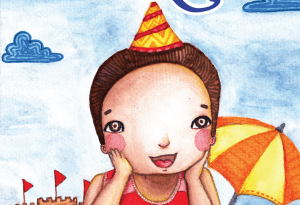
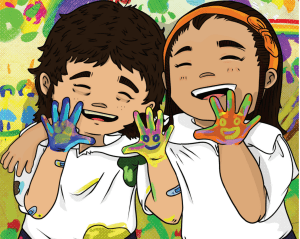
The book shows the many faces of children when they feel different emotions in different situations. Children feel happy when they play with playmates, when they read a book with a parent, when they watch a funny show with the family, or even when they are just by themselves. Children may feel sad when a parent leaves, a pet dies, when they are scolded, when they have no one to play with, when they are sick, when their parents are too busy, or when they are fighting with a sibling. They may also feel angry when they do not get what they want, when they fight with each other or with a parent, or when somebody takes away their toy. There are times when children also feel frightened – when it is dark, when there is lightning and thunder, when they imagine monsters or ghosts, when they have a bad dream, or when they break something in the house and their parents get mad. Often, children also feel shy especially when entering the classroom for the first time, when meeting another adult, when being befriended by another child, when performing, or being given something. But, they can also be brave when they defend each other from bullies, when they go to the doctor, or when they go inside the school or the classroom on their own.

Content reviewed by Dr. Jocelyn Tuguinayo, Department of Education – Bureau of Learning Delivery Title translations reviewed by the Department of Education – Region 7 Curriculum and Learning Management Division 2017 by U.S.Agency for International Development (USAID) Produced for the Department of Education under the USAID Basa Pilipinas Activity Basa Pilipinas is USAID/Philippines’ flagship basic education activity in support of the Philippine Government’s early grade reading program. Implemented in close collaboration with the Department of Education (DepEd), Basa Pilipinas aims to improve the reading skills for at least one million early grade students in Filipino, English and two mother tongue languages (Ilokano and Sinugbuanong Binisaya).This will be achieved by improving reading instruction, reading delivery systems, and access to quality reading materials. The publisher does not represent nor claim ownership over them.
Published by USAID • License:

Published by USAID

License:

Similar content

Sa Among Eskuylahan

Sa Among Eskuylahan

Week 2.

Author: Rosemarie Lofranco

The Kinder class is set to take a tour around the school. They will get to know the different people in school, where they work, and what they do. The teacher paired the children up in a “buddy system” and reminded them to stay with the group so they will not get lost. They went to the principal’s office, the library, the canteen, and the clinic. One boy was excited to read the books in the library and told his “buddy” that they should go back there. They did go back to the library and looked at different books. The Kinder class arrives at the school grounds where the teacher gives them time to play with their classmates. She notices, however, that there are two children missing. The librarian then comes with the two children with him. The teacher talked to the two children and told them that she was worried when she could not find them. She reminded them about the rules and said that they should have stayed with the class. The two children apologized to their teacher and promised that they will not do it again. The whole Kinder class then went to the library to read some books.

Content reviewed by Dr. Jocelyn Tuguinayo, Department of Education – Bureau of Learning Delivery Title translations reviewed by the Department of Education – Region 7 Curriculum and Learning Management Division 2017 by U.S.Agency for International Development (USAID) Produced for the Department of Education under the USAID Basa Pilipinas Activity Basa Pilipinas is USAID/Philippines’ flagship basic education activity in support of the Philippine Government’s early grade reading program. Implemented in close collaboration with the Department of Education (DepEd), Basa Pilipinas aims to improve the reading skills for at least one million early grade students in Filipino, English and two mother tongue languages (Ilokano and Sinugbuanong Binisaya). This will be achieved by improving reading instruction, reading delivery systems, and access to quality reading materials. The publisher does not represent nor claims ownership over them.

Malipayon kon Magkuyogay

Malipayon kon Magkuyogay

Week 3.

Author: Angeli Ludovico

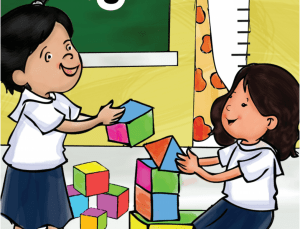
The teacher asks her Kindergarten class to draw something that they can do by themselves. One girl is very happy with the activity because she loves to draw. During snack time, the teacher approaches the girl and asks her why she is eating by herself and is not playing with the other children. The girl says she is shy and thinks that the other children may not like her. After snacks, the teacher asks her the class to work in pairs and draw what they can do together. One outgoing girl approaches the shy girl and asks her to be her partner. They start to draw the things that they can do together. After drawing, the teacher asks the partners to build a tower of blocks together. The two girls disagree on the kind of block tower that they want to make. The teacher talks to them and asks how they can work together. The two girls agree on a design that will make both of them happy. From then on, the two girls become inseparable best friends. They also learn how to work well with their other classmates even when they do not agree at first.

Content reviewed by Dr. Jocelyn Tuguinayo, Department of Education – Bureau of Learning Delivery Title translations reviewed by the Department of Education – Region 7 Curriculum and Learning Management Division 2017 by U.S.Agency for International Development (USAID) Produced for the Department of Education under the USAID Basa Pilipinas Activity Basa Pilipinas is USAID/Philippines’ flagship basic education activity in support of the Philippine Government’s early grade reading program. Implemented in close collaboration with the Department of Education (DepEd), Basa Pilipinas aims to improve the reading skills for at least one million early grade students in Filipino, English and two mother tongue languages (Ilokano and Sinugbuanong Binisaya). This will be achieved by improving reading instruction, reading delivery systems, and access to quality reading materials. The publisher does not represent nor claims ownership over them.

Damgo ni Mat

Damgo ni Mat

Week 6

Author: May-Ann Grace Samputon

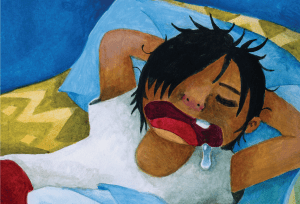
Mat is a healthy boy who just loves to lie down all day. One day, his mother asks him to help her fetch some water. Mat pretends that his hand and feet are in pain so he does not have to do what his mother asks. His mother becomes worried and asks him to go back to sleep. While sleeping, Mat dreams that a large snake is chasing him. He wants to climb a tree but he has no hands and feet. The snake is about to get him but Mat wakes up! He wakes up scared and crying and apologize to his mother for lying. From then on, he always helps his mother do chores around the house.

Content reviewed by Dr. Jocelyn Tuguinayo, Department of Education – Bureau of Learning Delivery Title translations reviewed by the Department of Education – Region 7 Curriculum and Learning Management Division 2017 by U.S.Agency for International Development (USAID) Produced for the Department of Education under the USAID Basa Pilipinas Activity Basa Pilipinas is USAID/Philippines’ flagship basic education activity in support of the Philippine Government’s early grade reading program. Implemented in close collaboration with the Department of Education (DepEd), Basa Pilipinas aims to improve the reading skills for at least one million early grade students in Filipino, English and two mother tongue languages (Ilokano and Sinugbuanong Binisaya).This will be achieved by improving reading instruction, reading delivery systems, and access to quality reading materials. The publisher does not represent nor claim ownership over them.
Si Rose ug Si Alma

Si Rose ug Si Alma

Week 9.

Author: Pablito Petallar

Rose and Alma are best friends who like to play and do many things together. But, they are different in many ways. Rose sleeps early every night, so she wakes up early and well-rested the next morning. She helps her mother cook breakfast and eats a healthy meal. She takes a bath and dresses up very neatly. Alma, on the other hand, watches TV all night so she has difficulty waking up in the morning. Because she almost always wakes up late, she does not have time to eat breakfast and take a bath. She dresses up hurriedly, too. Rose arrives in school early while Alma shows up late. During snack time, Rose eats healthful food and drinks milk while Alma eats only eats sweets, soda and chips. In the classroom, Rose does her tasks well while Alma often falls asleep. Since Alma does not take a bath before going to school, none of the children want to play with her. Rose invites Alma to play jump rope with her, but Alma trips and hurts herself because she easily gets tired. Rose comforts Alma and tells her how she can be strong and healthy. From then on, Alma sleeps early, takes a bath in the morning, and eats healthy food. Alma changes and becomes happier and healthier.

Content reviewed by Dr. Jocelyn Tuguinayo, Department of Education – Bureau of Learning Delivery Title translations reviewed by the Department of Education – Region 7 Curriculum and Learning Management Division 2017 by U.S.Agency for International Development (USAID) Produced for the Department of Education under the USAID Basa Pilipinas Activity Basa Pilipinas is USAID/Philippines’ flagship basic education activity in support of the Philippine Government’s early grade reading program. Implemented in close collaboration with the Department of Education (DepEd), Basa Pilipinas aims to improve the reading skills for at least one million early grade students in Filipino, English and two mother tongue languages (Ilokano and Sinugbuanong Binisaya).This will be achieved by improving reading instruction, reading delivery systems, and access to quality reading materials. The publisher does not represent nor claim ownership over them.